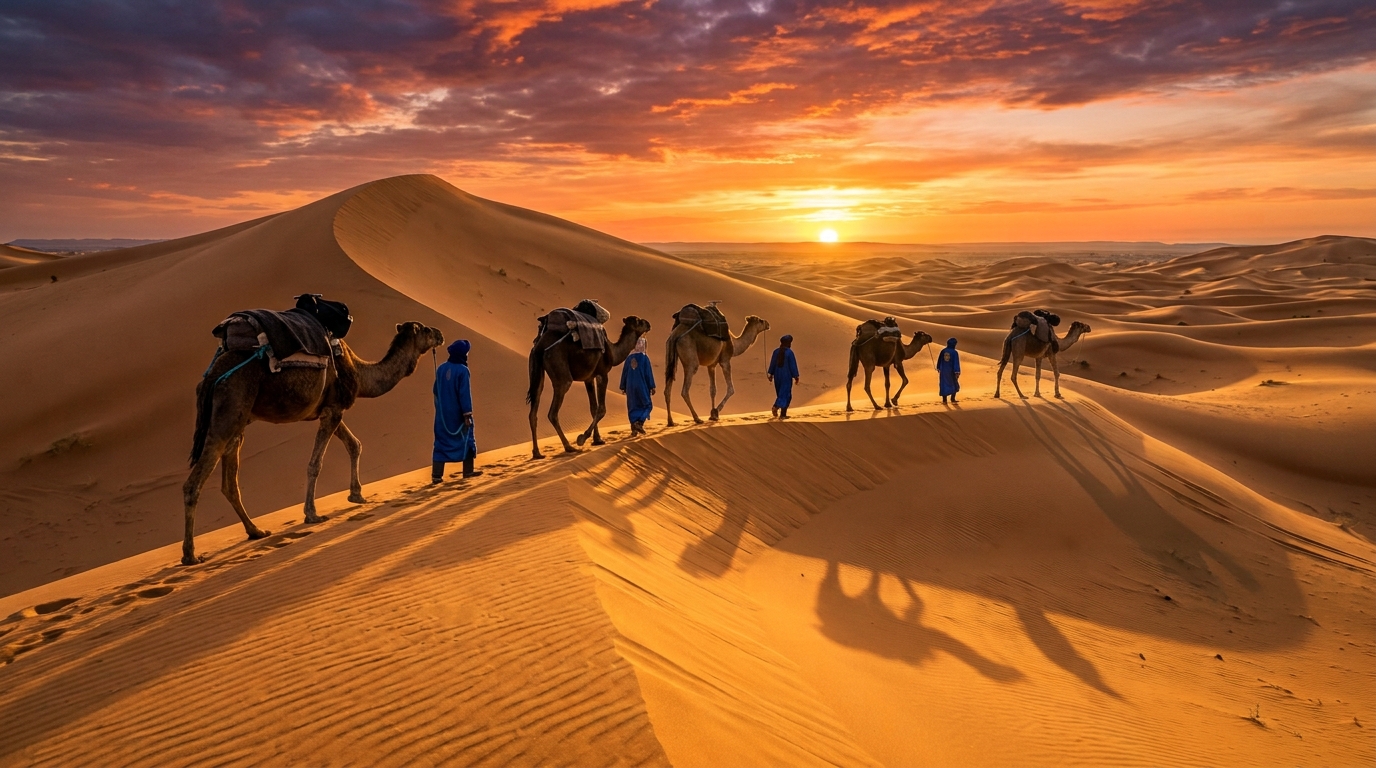

Golden dunes rolling to the horizon, camel caravans silhouetted against a fiery sunset, and a night sky so dense with stars it feels like the universe switched on every light at once — welcome to the Morocco Sahara Desert, one of the most mesmerizing landscapes on Earth. A journey into the Moroccan Sahara is more than just a trip; it is an adventure through time, culture, and nature’s raw beauty. From riding camels over rolling sand hills just as Berber nomads have done for centuries, to falling asleep in a desert camp beneath a sky full of stars, this is a once-in-a-lifetime experience.
In this complete guide, we will walk you through everything you need to plan the perfect Sahara adventure: the best gateway towns, camel treks, Berber hospitality, stargazing, sandboarding, ancient kasbahs, fossil fields, off-road safaris, plus a ready-to-use itinerary, transportation tips, food recommendations, and honest weather advice. Let’s embark on a journey through Morocco’s great desert, where ancient traditions meet breathtaking scenery.
Why the Moroccan Sahara Is a Once-in-a-Lifetime Adventure
The Sahara is the world’s largest hot desert, and Morocco offers one of the most accessible and beautiful gateways into it. Here, endless golden dunes rise like frozen waves, palm-filled oases spring from arid plains, and fortified clay villages tell stories of ancient caravan routes. Whether you dream of a sunset camel ride, a drum-filled evening around a campfire, or simply lying on warm sand watching the Milky Way drift by, the Morocco Sahara Desert delivers moments that stay with you forever.
Arriving in the Desert: Gateway Towns and Routes
Your adventure typically begins in Marrakech or Fez, Morocco’s bustling imperial cities. These vibrant centers — with their labyrinthine medinas, sizzling food stalls, and ornate riads — serve as starting points for the long yet scenic drive into the Sahara. The two most popular desert gateways are Merzouga and Zagora, each offering a different flavor of desert magic.
Merzouga and the Erg Chebbi Dunes
Merzouga, a small town on the edge of the famous Erg Chebbi dunes, is the classic choice for first-time visitors. These towering sand hills, some reaching up to 150 meters (500 feet), stretch endlessly toward the horizon and deliver the postcard-perfect Sahara you have always imagined. The drive from Marrakech takes roughly 9–10 hours (around 560 km), while from Fez it is about 7–8 hours — which is why most travelers break the journey with scenic stops.
Zagora and the Draa Valley
Zagora, closer to Marrakech (around 6–7 hours), is perfect if your schedule is tighter. Its dunes are smaller but no less magical, and the route follows the Draa Valley, home to one of Morocco’s longest rivers and lush date palm groves that seem to march forever toward the horizon.
The Road In: High Atlas, Todra Gorge and Oases
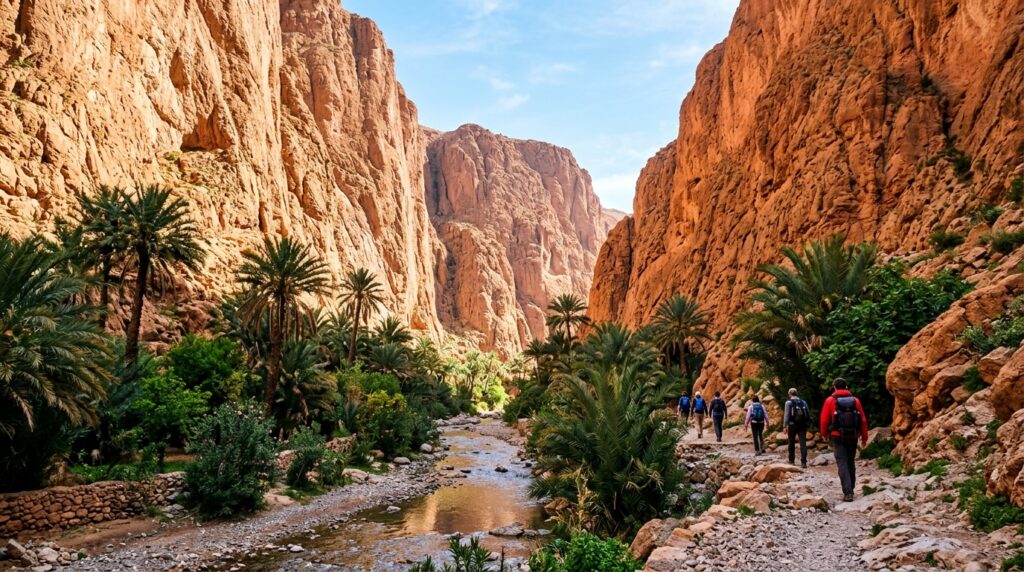
The drive itself is half the adventure. Heading to Merzouga, you cross the High Atlas Mountains, pass palm-filled oases, and explore storied kasbahs. A highlight is the breathtaking Todra Gorge, where towering red rock cliffs squeeze a green canyon oasis into a dramatic slot canyon. Zagora-bound travelers instead glide through the date palms of the Draa Valley, stopping at mud-brick kasbahs and weekly souks.
Riding Camels into the Dunes: A Nomadic Tradition
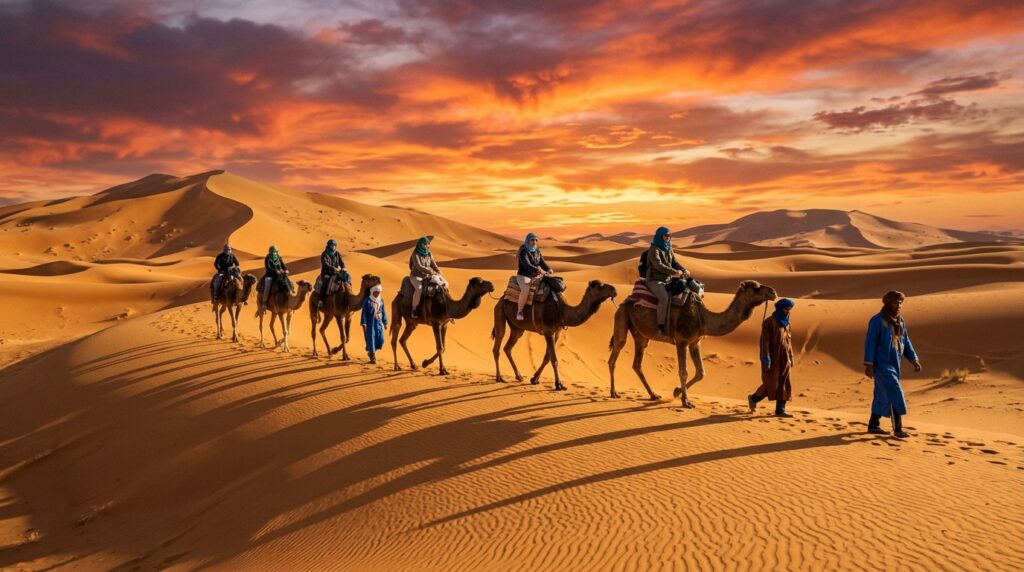
There is no better way to enter the Sahara than on the back of a camel, just as Berber nomads have done for centuries. As your camel train sways through the golden dunes in the soft light of late afternoon, you will feel transported to another world — one of complete silence, broken only by the whisper of the wind against the sand.
Most camel treks from Merzouga last about 1 to 1.5 hours each way, timed so you arrive at camp as the sky transforms into a canvas of fiery reds, deep purples, and soft oranges, casting long shadows over the desert floor. It is a sight you will never forget. Tip: bring a scarf to shield from swirling sand, hold the saddle horn on uphills, and lean back on descents — your camel knows the way, but your posture makes the ride smoother.
Experiencing Berber Hospitality in a Desert Camp
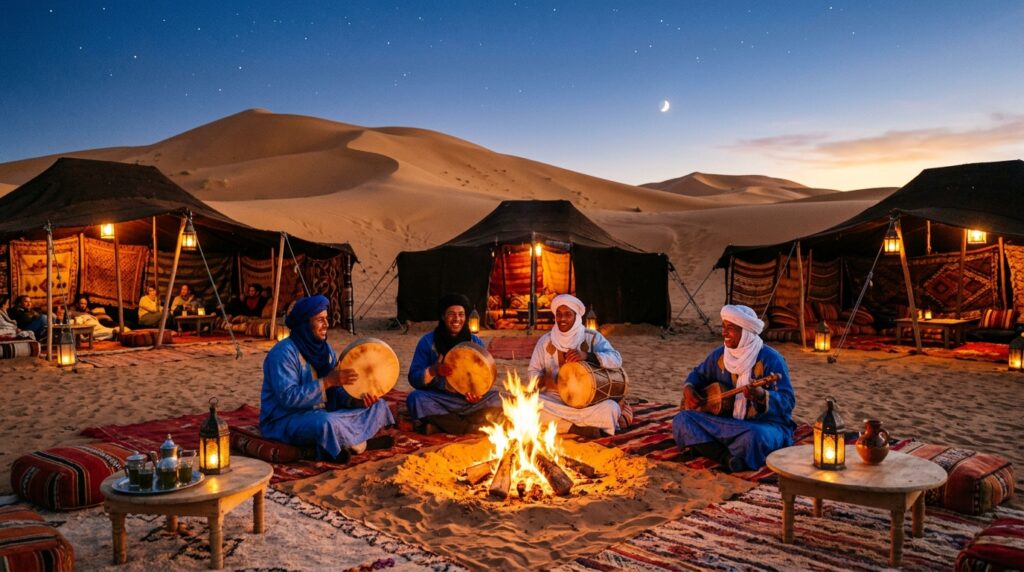
After your camel trek, you will arrive at your Berber desert camp, where warm smiles, sweet mint tea, and legendary Moroccan hospitality await. The Berbers, the indigenous people of North Africa, have lived in the Sahara for centuries, and staying in their camps offers a genuine glimpse into nomadic life.
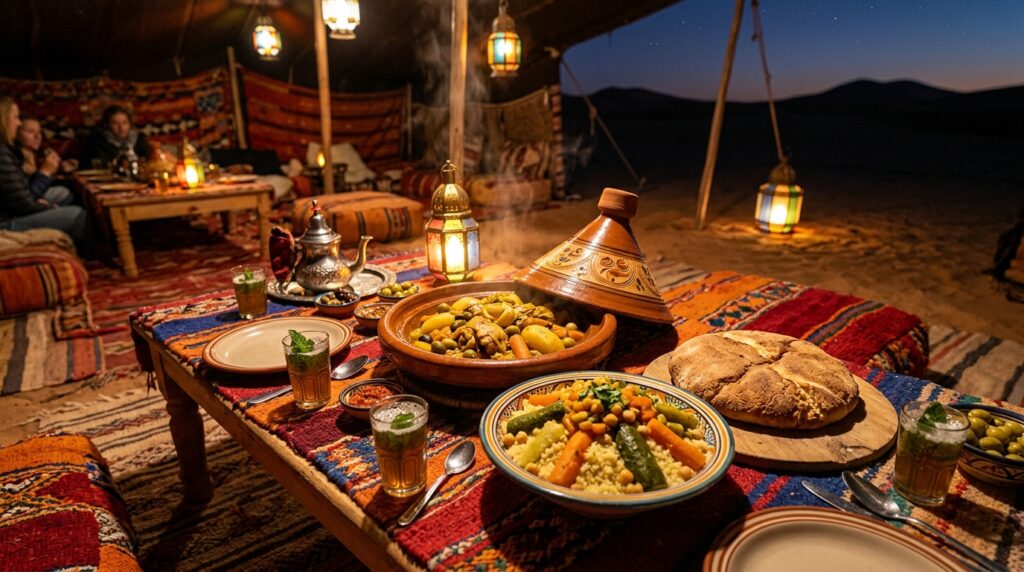
Dinner is a feast of Moroccan flavors: tagine (a slow-cooked stew of chicken, lamb, or vegetables), fluffy couscous, and fresh bread baked in the sand under hot coals. In the Merzouga region, also try madfuna, a stuffed Berber pizza bursting with spiced meat and vegetables. As you sit around the campfire, the sound of Berber drums fills the air while locals share ancient songs and stories of the desert. There is no rush here — just the slow rhythm of desert life, where time seems to stand still.
Camps range from simple, rustic tents with shared facilities and blankets under the open sky, to luxury camps with comfortable beds, private bathrooms, and even solar-powered lighting. Whichever you choose, the warmth is identical.
Sleeping Under a Sky Full of Stars
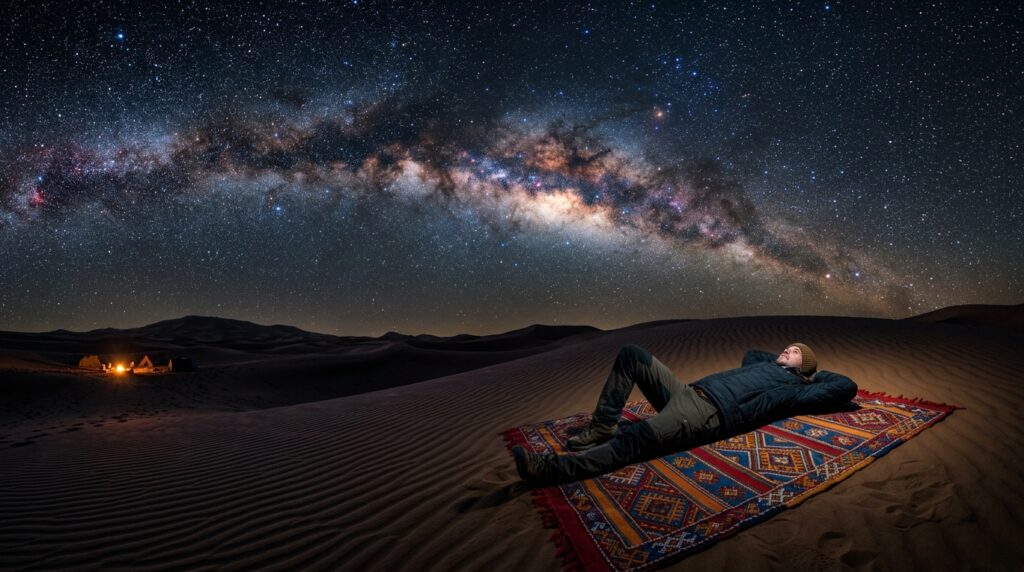
One of the most breathtaking aspects of the Morocco Sahara Desert is its night sky. With zero light pollution for miles, the desert offers one of the clearest views of the Milky Way, constellations, and even distant planets anywhere on the planet. Lying on the warm sand and looking up at the vast universe above is an almost surreal experience — the silence is so complete you can hear your own heartbeat.
Photography tip: bring a small tripod, use a wide-angle lens, set a long exposure (15–25 seconds), and let the stars paint themselves across your memory card. On clear nights, shooting stars appear every few minutes — make a wish, you will have plenty.
Waking Up to a Desert Sunrise
The sunrise in the Sahara is just as spectacular as the sunset. As the first light of dawn touches the dunes, the sands turn shades of pink, gold, and red. Most camps offer an early morning camel trek or dune climb so you can witness this breathtaking moment from the summit. Sitting atop a camel as the sun rises over an endless sea of sand is pure tranquility — a reminder of how vast and beautiful the natural world is.
After sunrise, a simple Berber breakfast awaits: fresh bread, jam, honey, and steaming mint tea that prepares you perfectly for the journey back to civilization.
Sandboarding and Dune Hiking: Adventure in the Dunes
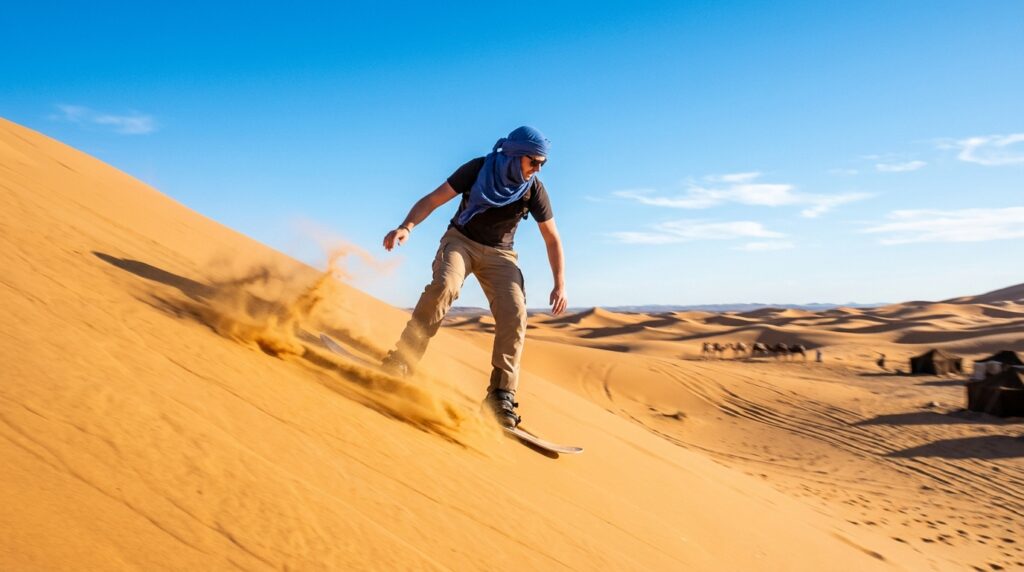
For thrill-seekers, the Sahara offers sandboarding — the desert’s answer to snowboarding. The slopes of Erg Chebbi provide perfect runs for gliding down soft sand at exhilarating speeds; your camp can usually arrange a board for a small fee.
Prefer something slower? Hiking up the tallest dunes is a rewarding challenge. Climbing through loose, shifting sand is harder than it looks, but the views from the top are absolutely worth it: endless waves of dunes stretching toward Algeria in an awe-inspiring panorama. Go barefoot at sunrise or sunset when the sand is cool — it is the best feeling in the desert.
Beyond the Dunes: Desert Villages, Kasbahs and Fossil Fields
Khamlia and the Gnawa People
Beyond the dunes, the Sahara is dotted with small villages, abandoned fortresses, and historic kasbahs. One of the most fascinating stops near Merzouga is Khamlia, home to the Gnawa people, descendants of enslaved Africans who brought unique music and traditions to the region. Their hypnotic drum rhythms and chants, played on the krakebs (metal castanets) and guembri (three-stringed lute), are an unforgettable, soul-stirring experience.
Ait Ben Haddou: A UNESCO Fortress
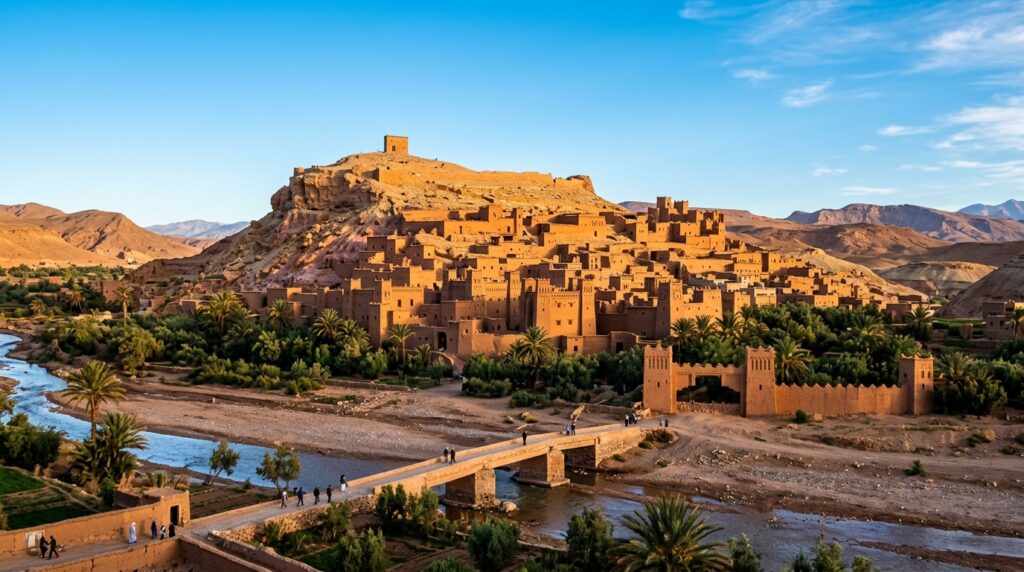
Further west, the Ksar of Ait Ben Haddou, a UNESCO-listed fortress, stands as one of Morocco’s most iconic sites. This ancient clay-built city has appeared in films and series like Gladiator and Game of Thrones, and walking its maze-like streets feels like stepping back in time. Climb to the rooftop granary for a sweeping view over the valley, then sip an orange juice at a terrace café across the river.
Erfoud Fossil Fields and the Black Desert
The Sahara was not always a desert — millions of years ago it was an ocean teeming with life. The region around Erfoud is famous for its fossils, including ancient marine creatures and spiral ammonites. Visit a fossil workshop to see how these prehistoric remains are extracted and polished, or take home a unique fossil souvenir. Geology lovers should also drive to the Black Desert near Merzouga, a stark landscape covered in dark volcanic rock that contrasts dramatically with the golden dunes.
Driving the Sahara: 4×4 Off-Road Safaris and Hidden Oases
If camels are not your style, exploring the Sahara by 4×4 vehicle is an exciting alternative. Local guides offer off-road desert safaris through hidden valleys, dry riverbeds, and towering dunes that are otherwise inaccessible. A 4×4 journey often includes stops at desert oases, where lush palm groves spring up in the middle of the arid landscape — hidden pockets of green that offer a refreshing contrast to the vast desert and a perfect picnic spot under the palms.
Best Time to Visit and Weather Advice
The best time to visit the Morocco Sahara Desert is from October to April, when daytime temperatures hover around a pleasant 20–28°C (68–82°F). Summers (June–August) can exceed 40–45°C (104–113°F) — dramatic, but demanding. Remember that the desert cools rapidly after sunset: winter nights can drop near 0°C (32°F), so pack layers even in autumn and spring.
Weather tips: always carry a headscarf or shemagh for wind and sand, high-SPF sunscreen, sunglasses, and 2–3 liters of water per day. Check the forecast for sandstorms, and plan camel treks for the golden hours just after sunrise or before sunset.
The Perfect 4-Day Morocco Sahara Desert Itinerary
Day 1 – Marrakech to the Atlas and Ouarzazate (approx. 6–7 h driving): Cross the Tizi n’Tichka pass, explore Ait Ben Haddou for 2 hours, and sleep in a kasbah guesthouse in Ouarzazate or the Skoura palm oasis.
Day 2 – Oases to Merzouga (approx. 5–6 h driving): Walk the canyon floor of Todra Gorge at sunrise, lunch in Tinghir, and reach Merzouga by late afternoon. Take your sunset camel trek (1–1.5 h) and sleep in a Berber camp under the stars.
Day 3 – Dunes, Drums and Fossils: Wake for the sunrise dune climb, sandboard after breakfast, then visit Khamlia for a Gnawa music session and Erfoud’s fossil workshops. Enjoy a 4×4 excursion to the Black Desert and a second night at camp or a desert hotel with a pool.
Day 4 – Return or Continue: Drive back toward Marrakech via the Draa Valley and Zagora for extra palm-grove scenery, or head north to Fez through the Ziz Valley gorges. Either way, you will arrive home with a camera full of gold and a heart full of stars.
Transportation Tips
- Private driver or guided tour is the most comfortable option for the Marrakech–Merzouga route and lets you stop freely at gorges and kasbahs.
- Public buses (CTM/Supratours) connect Marrakech to Ouarzazate, Errachidia, and Rissani; from Rissani, a grand taxi (about 40 minutes) completes the trip to Merzouga.
- Renting a car works well too — roads are paved all the way to Merzouga, but avoid driving dunes without a 4×4 and an experienced guide.
- For Zagora, trains run Marrakech to Ouarzazate via bus connection, making it an easy 2-day loop.
Note: visa rules, bus schedules, and fares can change over time — always double-check official sources before traveling.
What to Pack for the Sahara
Light, breathable clothing for day; a warm fleece and hat for night; closed shoes for dune hikes plus sandals for camp; a shemagh scarf; sunscreen and lip balm; a headlamp; a power bank (electricity can be limited); and a small daypack for the camel trek — your main luggage can stay at your hotel or desert depot.
Frequently Asked Questions
How many days do I need?
Allow at least 3 days from Marrakech for Merzouga, or 2 days for Zagora. Four to five days lets you savor the route.
Merzouga or Zagora — which is better?
Merzouga wins for towering Erg Chebbi dunes and classic camps; Zagora wins for shorter drives and lush Draa Valley scenery.
Is a desert camp safe and comfortable?
Yes. Camps are run by experienced local families; luxury options add real beds and private bathrooms. Nights are cold — bring layers.
What does it cost?
Budget group tours start affordably, while private luxury camps cost significantly more. Prices change with season, so compare current offers.
Do I need a visa for Morocco?
Many nationalities enter visa-free for up to 90 days, but policies may change — verify with your embassy before booking.
Final Thoughts: A Journey to Remember
As your time in the Sahara comes to an end, the journey back to Marrakech or Fez offers one last chance to soak in the magic of the desert. The contrast between the endless golden sands and the bustling city streets makes you appreciate the Sahara’s quiet beauty even more. The memories of sleeping under the stars, riding camels through the dunes, and feeling the desert’s vastness will stay with you forever. The Morocco Sahara Desert is not just a destination — it is a feeling, a rhythm, and a sky full of stars calling you back. Pack your scarf, charge your camera, and go meet the dunes.