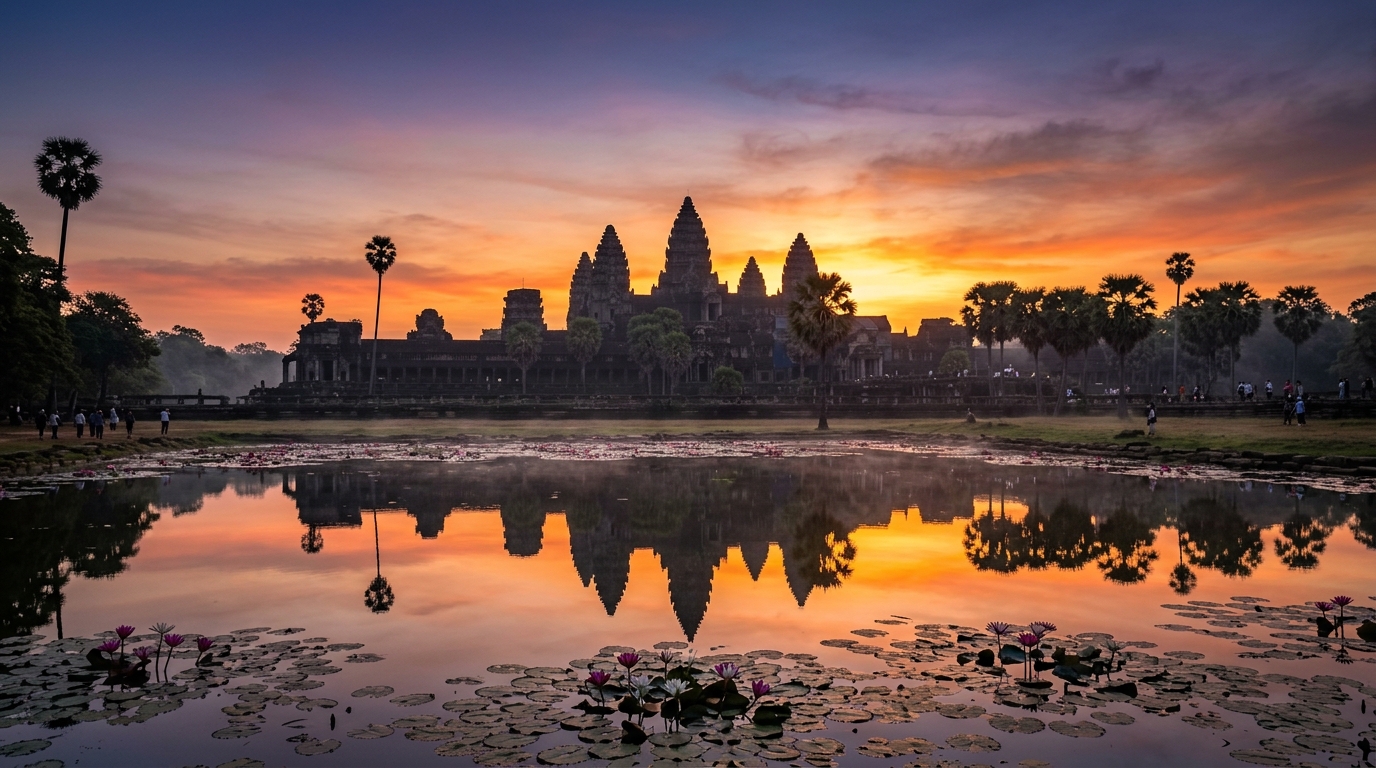

Step back in time and discover a place that doesn’t simply sit in the landscape — it rises out of a dream. Nestled in the dense jungles of Cambodia, Angkor Wat is one of the most iconic and historically significant archaeological sites on the planet, a UNESCO World Heritage Site where sunrise ignites ancient towers and jungle roots wrap around stone like slow, patient hands.
Whether you’re waiting for first light at the reflecting pools, wandering beneath the smiling stone faces of Bayon, or ducking under colossal tree roots at Ta Prohm, Angkor doesn’t just show you history — it lets you walk through it.
In this ultimate Angkor Wat guide, we’ll explore the rich history, mind-bending architecture, and must-visit temples of the Angkor Archaeological Park, then hand you the practical tools to plan the perfect trip: tickets, transport, weather, food, temple etiquette, and a ready-to-use one-day itinerary for Cambodia’s most iconic wonder.
The Story of Angkor Wat: A Temple Built to Mirror the Cosmos
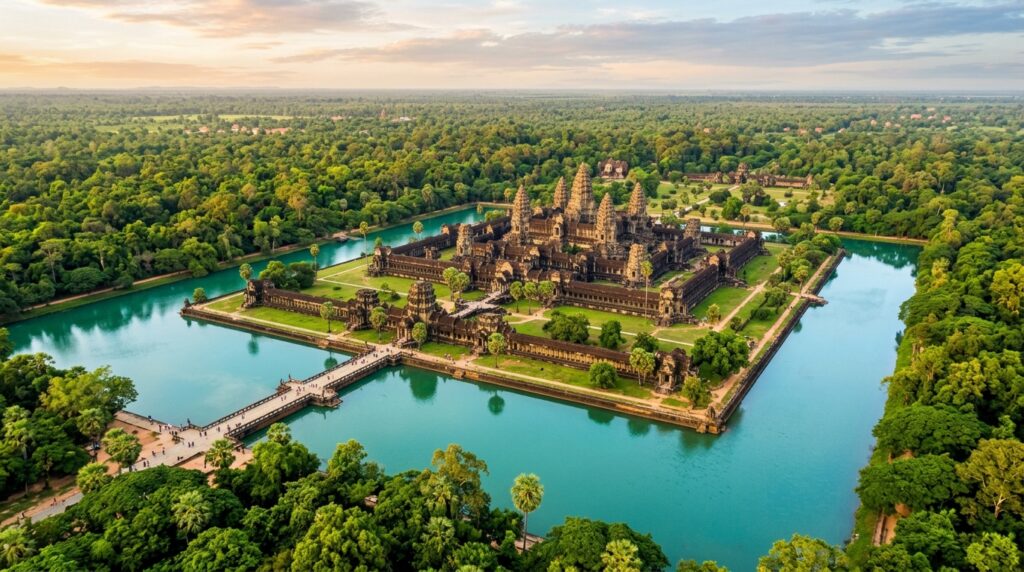
The story of Angkor Wat begins in the early 12th century, when King Suryavarman II commissioned a temple unlike anything the world had ever seen. Originally designed as a Hindu temple dedicated to the god Vishnu, the complex was built to represent Mount Meru, the mythical home of the Hindu gods. Its five towering lotus-shaped towers symbolize the mountain’s peaks, while the vast moat surrounding the walls represents the cosmic ocean.
As Cambodia’s religious landscape evolved, Angkor Wat gradually transitioned from a Hindu sanctuary into a Buddhist site — a living spiritual center where worship continues to this day. European explorers rediscovered the temple in the 19th century and wrote breathless accounts of stone palaces swallowed by jungle, and since then Angkor has become a global symbol of Cambodia’s rich cultural heritage, drawing more than two million visitors every year.
And here is the fact that puts everything in perspective: Angkor Wat covers a staggering 162 hectares — 400 acres — making it nearly four times the size of Vatican City and, by far, the largest religious monument ever constructed. Unlike ancient wonders that survive as crumbled ruins, Angkor Wat is a fully intact masterpiece, standing strong against the test of time.
The Soul of a Nation: The Only Temple on a National Flag
For Cambodians, Angkor Wat is far more than a historical site — it is the soul of their nation. The temple is so deeply ingrained in the country’s identity that it appears on the national flag, making Cambodia the only country in the world to feature a religious monument on its flag.
For centuries the temple has been a symbol of strength, resilience, and cultural pride. Even during Cambodia’s darkest times, including the Khmer Rouge era, Angkor Wat remained a beacon of hope and continuity. Today it serves as a powerful reminder of the country’s rich heritage and enduring legacy — and a visit here feels less like tourism and more like paying respects to a living national spirit.
The Mystery of Its Construction
Here is where Angkor Wat becomes truly astonishing. Despite being built in the 12th century — without cranes, trucks, or modern tools — the temple was constructed using enormous sandstone blocks, some weighing up to 1.5 tons each. The stones were quarried at the holy mountain of Phnom Kulen, more than 50 kilometers away.
So how did ancient Khmer engineers transport these massive blocks across the jungle? Some theories suggest an elaborate system of canals and rafts floated the stones down the Siem Reap River. Others believe an intricate network of wooden rollers, ropes, and elephants hauled them overland.
Even more impressive is the precision. Unlike the pyramids of Egypt, no mortar was used at Angkor Wat. The blocks were cut so carefully that they interlock seamlessly, like a giant three-dimensional puzzle — one of the main reasons the temple has survived centuries of monsoons, heat, and history itself.
A Temple Aligned With the Heavens
Most Hindu temples face east, the direction of life and rebirth. Angkor Wat, mysteriously, faces west — a direction traditionally associated with death in Hinduism. Why?
Some scholars believe the temple was designed as a giant funerary temple for its builder, King Suryavarman II, who wished to be worshiped as a deity after his death. Others argue the westward alignment honors Vishnu, the god associated with the setting sun.
The most fascinating detail, however, is astronomical: during the spring and autumn equinoxes, the sun rises directly over Angkor Wat’s central tower, perfectly aligned with the temple’s axis. It’s a moment that reinforces the idea that Angkor Wat was built as a cosmic gateway between the human and divine worlds — and proof that Khmer architects were also master astronomers.
Walking the Bas-Reliefs: 600 Meters of Carved Mythology
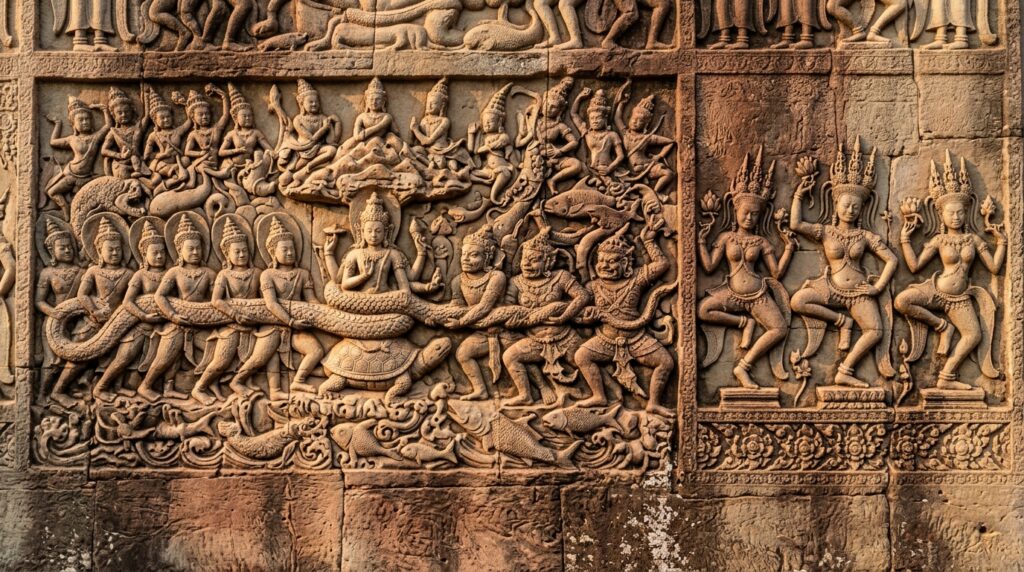
Walking through Angkor Wat’s galleries, you’ll be surrounded by some of the finest stone carvings on Earth. The temple’s famous bas-reliefs stretch across roughly 600 meters of walls, telling epic stories of gods, demons, and celestial beings.
The most celebrated scene is the Churning of the Ocean of Milk, a dramatic episode from Hindu mythology depicting the battle between gods and demons to obtain the elixir of immortality. The level of detail is astounding — you can distinguish individual facial expressions, hairstyles, and ornaments on figures carved nearly nine centuries ago.
Each wall tells a different tale, from ancient battles to divine processions, offering a glimpse into the Khmer Empire’s artistic genius and religious devotion. Allow at least 45–60 minutes to walk the galleries slowly; it’s the closest thing to reading a book carved in stone.

Bayon Temple: The Smiling Faces of Angkor Thom
While Angkor Wat is the crown jewel of the park, Bayon Temple, located at the heart of the walled city of Angkor Thom, is its most surreal masterpiece. Built in the late 12th century by King Jayavarman VII, Bayon is famous for its 216 massive stone faces carved into its towers, each wearing a gentle, enigmatic smile believed to represent either the king himself or the bodhisattva of compassion, Avalokiteshvara.
Standing amidst these colossal faces, one feels an almost mystical presence — as if the temple itself is quietly watching over its visitors. Wander the narrow corridors and steep staircases slowly, and if you can, visit in late afternoon when the light turns golden and the faces seem to glow from within.
Ta Prohm: The Jungle Temple That Swallowed History
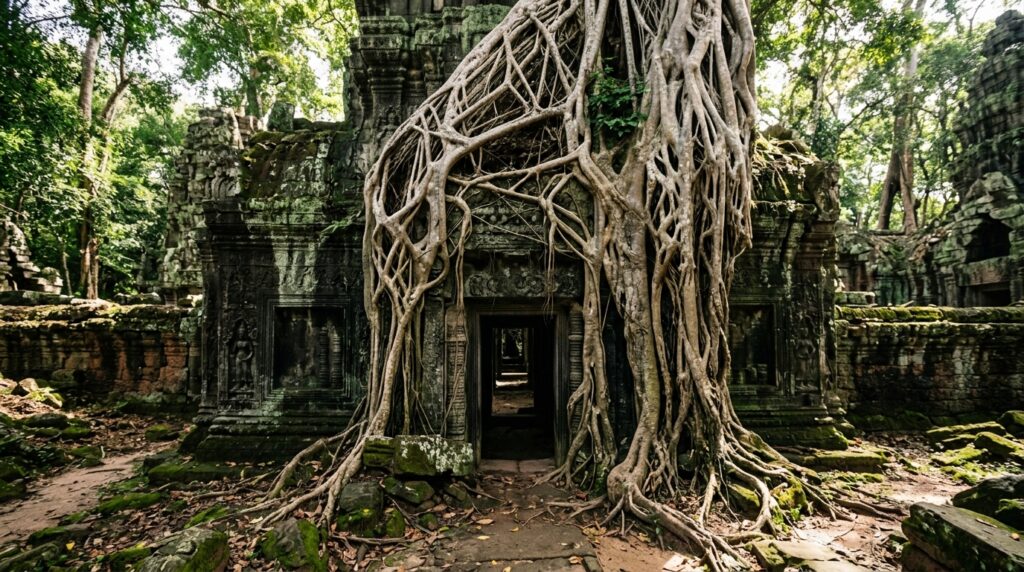
If Angkor Wat feels majestic and Bayon feels mystical, Ta Prohm feels otherworldly. Unlike other temples in the park, Ta Prohm was left largely in its natural state — a living example of nature reclaiming history.
Giant strangler figs and silk-cotton trees weave through the ruins, their roots bursting through walls and intertwining with ancient carvings like enormous hands. Made famous worldwide by the movie Tomb Raider, Ta Prohm is the place where you’ll feel like an explorer stumbling into a lost world — a delicate, hauntingly beautiful balance of jungle and stone.
Go mid-morning, after the sunrise crowds have moved on, and slip into the quieter eastern galleries for a rare moment of near-silence among the roots.
How to Witness the Best Sunrise in the World
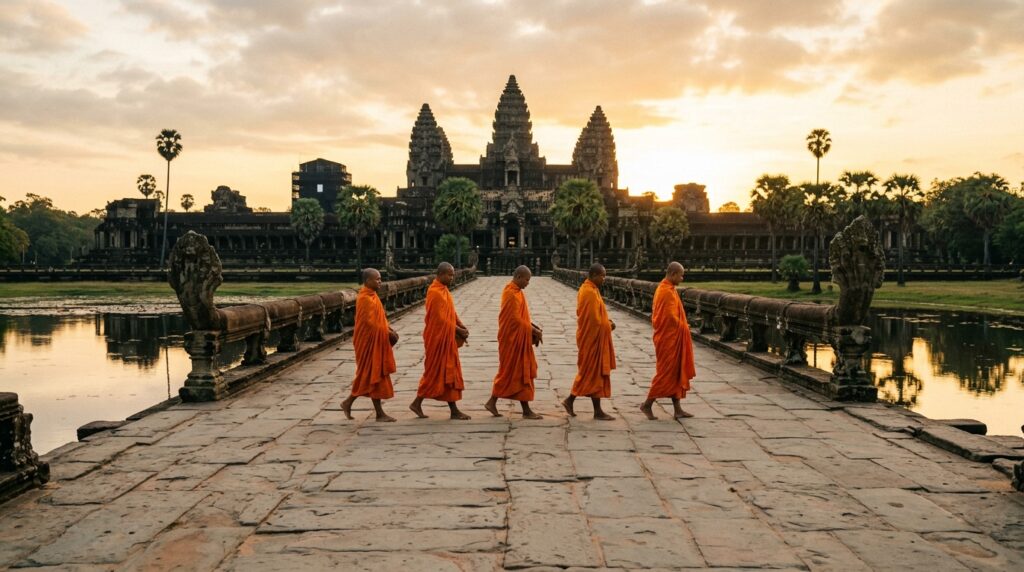
Few sights on Earth compare to an Angkor Wat sunrise. Every morning before dawn, travelers gather around the temple’s reflecting pools, waiting in the dark as the silhouette of the five towers emerges against a sky that turns from deep purple to fiery orange. It is one of the most photographed sunrises on the planet, and experiencing it in person is nothing short of magical.
Practical sunrise tips:
- Leave Siem Reap around 5:00–5:15 AM; the park opens early for sunrise visitors.
- Head to the northern reflecting pool (on the left as you face the temple) for the classic postcard reflection.
- Bring a small flashlight and a light layer — it can feel surprisingly cool before dawn.
- Stay after the sunrise! Most of the crowd leaves for breakfast around 7:00 AM, giving you a golden window to explore the temple almost alone.
Hidden Chambers: The Secrets Still Buried Beneath
Despite centuries of study, Angkor still holds secrets. Discoveries have revealed hidden chambers, underground tunnels, and even an unfinished tower within the complex. Some archaeologists believe undiscovered relics or scriptures may still lie buried beneath the stones, waiting to be unearthed.
Modern laser-mapping surveys have additionally shown that Angkor was once part of a vast medieval metropolis — a sprawling network of roads, canals, and suburbs hidden under jungle and rice fields. The temple surrenders its mysteries slowly, which is exactly why a visit here feels like stepping into an ongoing discovery.
Planning Your Visit: Tickets, Transport & Best Time to Go
Base camp: Siem Reap is the gateway town, located just 6 km (about 15–20 minutes) from the Angkor Archaeological Park. It’s packed with cafés, markets, and hotels for every budget.
Tickets (Angkor Pass): A 1-day pass costs around $37, a 3-day pass around $62, and a 7-day pass around $72, with your photo taken on the spot at the official ticket office. Honest advice: if your schedule allows, choose the 3-day pass — one day is never enough. Please note that ticket prices, visa rules, and flight options can change over time, so always double-check official sources before traveling.
Best time to visit:
- November–February: dry and coolest — perfect for sunrise chasing and long temple days.
- March–May: hot season; start early, hydrate constantly, and rest during midday heat.
- June–October: green season; moats fill, the jungle turns lush, crowds thin out, and short dramatic downpours refresh the ruins.
Getting around the park:
- Tuk-tuk: the classic choice, roughly $15–20 per day with a driver who knows the circuits.
- Bicycle: for the fit and adventurous, around $5 per day on flat, shaded roads.
- E-bike or private car with driver: ideal in the hot season or for families.
Temple etiquette & dress code: Angkor is a sacred site. Cover shoulders and knees, remove hats inside shrine areas, never touch or climb on carvings, keep your voice low near monks and worshippers, and always ask permission before photographing people.

The Perfect One-Day Angkor Itinerary
- 5:00 AM – Tuk-tuk pickup; sunrise at Angkor Wat’s reflecting pools (about 1.5 hours).
- 7:30 AM – Breakfast in Siem Reap; try a crispy num pang sandwich and Khmer iced coffee.
- 9:00 AM – Angkor Thom: enter through the monumental South Gate, explore Bayon (1–1.5 hours), then Baphuon, the Terrace of the Elephants, and the Terrace of the Leper King.
- 12:30 PM – Lunch near the park entrance or back in town for air-conditioned comfort.
- 2:30 PM – Ta Prohm, the jungle temple, at its most atmospheric (about 1.5 hours).
- 4:30 PM – Ta Keo or Chau Say Tevoda on the way out.
- 5:00 PM – Sunset at Pre Rup, a pyramid temple whose bricks glow rose-gold at dusk.
What to Eat in Siem Reap: Khmer Flavors You Can’t Miss
Temple exploring burns serious energy, and Siem Reap is one of the most delicious towns in Southeast Asia. Don’t leave without tasting:
- Fish amok – Cambodia’s signature dish: a silky curry steamed in a banana leaf with coconut and fragrant kroeung spice paste.
- Beef lok lak – tender stir-fried beef with Kampot pepper and a lime dipping sauce.
- Khmer red curry – smoky, mild, and aromatic, served with fresh baguette.
- Nom banh chok – the beloved Khmer noodles breakfast of rice noodles with green fish curry.
- Banana blossom salad & fresh spring rolls – bright, herby, and perfect on a hot day.
Where to eat: graze the stalls around the Old Market (Psar Chas), hit the Siem Reap Night Market for skewers and sweets, and cool down on Pub Street with a mango shake. For a memorable evening, book an Apsara dance dinner show — culture and cuisine on one plate.
Cultural Highlights: Meet the Living Heritage
Angkor is not a museum piece; it’s a living spiritual landscape. You’ll see saffron-robed monks crossing causeways at dawn and locals praying at shrines between the towers. Greet people with a sampeah — palms together, a slight bow — and you’ll be welcomed with warm smiles. Before you leave town, visit a fair-trade artisan workshop such as Artisans Angkor to watch silk weaving and stone carving keep Khmer craftsmanship alive.
Final Thoughts: Why Angkor Wat Stays With You
Angkor Wat is more than a checklist stop — it’s a encounter with human ambition, devotion, and imagination at their absolute peak. From the world’s best sunrise to temples strangled by jungle roots, from 600 meters of carved mythology to smiling stone faces that follow you through the corridors, this is one wonder that fully lives up to its legend. Go early, wander slowly, and let the jungle temple work its nearly 900-year-old magic on you.
Frequently Asked Questions
How many days do I need at Angkor Wat?
One day covers the highlights (Angkor Wat, Bayon, Ta Prohm), but a 3-day pass lets you explore outer temples like Banteay Srei and Beng Mealea at a relaxed pace.
What is the best month to visit Angkor Wat?
November to February offers dry, cooler weather — ideal for sunrise visits. The green season (June–October) rewards you with lush jungle and smaller crowds.
Is Angkor Wat worth visiting?
Absolutely. It’s the largest religious monument on Earth and one of the few ancient wonders you can still explore intimately, from dawn to dusk.
Can I visit Angkor Wat without a tour?
Yes. Hire a tuk-tuk driver in Siem Reap, rent a bicycle, or book a private car — the park is well signposted and easy to navigate with this guide in hand.